
Skip to the main content.

about_mega


Your Path to Medical School Success

MedEdits Medical Admissions is the nation's premier medical school admissions consulting firm. Since 2007, founder Jessica Freedman, M.D., and our team of physician educators have guided thousands of aspiring medical professionals through their premedical and medical school journey. Our faculty advisors bring invaluable insider knowledge from serving on medical school admissions committees, education committees, and hospital boards. Combined with our specialized medical admissions writing coaches, we provide the comprehensive guidance and industry expertise essential for acceptance to medical school, residency, and fellowship programs.

9 min read

How to Structure a Medical School Personal Statement: Outline, Template, and Example

How to Structure a Medical School Personal Statement: Outline, Template, and Example

Every medical school personal statement answers the same basic question: why do you want to be a doctor? Because every applicant answers it, what separates a memorable essay from a forgettable one is rarely the topic. It is the structure: which experiences you choose, the order you present them in, and how clearly each one leads to the next. In this guide, I explain how to structure a medical school personal statement paragraph by paragraph, how to build an outline before you write, and how a strong essay is put together, using an annotated example.

I learned what works by reading thousands of personal statements as an admissions committee member and associate residency director at the Icahn School of Medicine at Mount Sinai, and later by advising applicants at MedEdits. If you would like to read full essays before you outline your own, see my medical school personal statement examples, each with commentary on why it works.

Why Structure Matters

Admissions committee members read a large number of personal statements each cycle, often in a single sitting. A well-structured essay is easy to follow: the reader knows where they are, why each experience is there, and how it connects to your decision to pursue medicine. A poorly structured essay forces the reader to work, and even strong experiences can get lost when they are presented as a list or in a confusing order.

The AAMC advises applicants to make sure their essay is interesting, follows a logical and orderly flow, and relates to their reasons for choosing medicine. That is a description of structure. The character limits are also tight: 5,300 characters with spaces for AMCAS and AACOMAS, and 5,000 for TMDSAS. With so little room, every paragraph needs a clear job. An outline is how you make sure it has one before you start writing.

"The applicants who stood out in committee were rarely the ones with the most activities. They were the ones whose essays made their path easy to understand and hard to forget."

The Narrative Structure Committees Expect

The application prompts effectively call for a narrative essay: a story of how you arrived at medicine, told in your own voice, with reflection woven throughout. A strong narrative personal statement opens with a vivid moment that draws the reader in, uses specific details rather than generic statements, and has an authentic point of view. It focuses on the ideas and values central to who you are, progresses logically from one experience to the next, and blends storytelling with reflection so the reader understands not only what happened but what it meant to you. By the end, it shows growth, maturity, and a realistic understanding of what physicians do.

Notice that none of those qualities requires a clever theme or literary flourishes. Most successful personal statements are somewhat autobiographical. What makes them work is a clear structure that lets the reader follow your thinking.

Before You Outline: Your Personal Inventory

You cannot outline well until you know which experiences belong in your essay. That is why I ask every applicant to start with the MedEdits Personal Inventory Exercise. List the most important experiences in your life in chronological order, mark the ones that most influenced your decision to pursue medicine, and write down why each mattered and what story illustrates it.

The exercise ends with your Foundational Statement: one or two sentences that capture why you want to be a physician and what kind of physician you hope to become. Your Foundational Statement is the spine of your outline. Every paragraph you plan should support it in some way, and any experience that does not support it probably belongs in your Work and Activities entries instead.

How to Outline Your Personal Statement, Paragraph by Paragraph

Most strong personal statements follow the same architecture: an opening story, a paragraph that reflects on it and connects it to your path, two or three body paragraphs on your most formative experiences, a synthesis that explains why medicine specifically, and a conclusion. Here is how to plan each part.

Paragraph 1: The Opening Story

Choose a specific moment from your personal inventory, one that was influential in setting you on your path and that you can describe vividly. Use sensory details and put the reader in the room with you. The best openings start in the middle of the action rather than with a statement about wanting to be a doctor. In your outline, write one sentence describing the moment and one sentence describing why you chose it. Plan for roughly 500 to 700 characters. For opening techniques and examples, see my guide on how to start a medical school personal statement.

Paragraph 2: Reflection and Origins

The second paragraph tells the reader why the opening story matters. What did you learn? How does it fit into your path to medicine? This is often where you introduce your background and how your interest in medicine first took root. In your outline, write down the insight the opening story revealed and the bridge to your earlier history. Plan for 500 to 800 characters.

Paragraphs 3 to 5: Your Most Formative Experiences

The body of your essay should cover two or three of the most significant experiences from your inventory: personal, clinical, academic, research, or service. At least some of them should directly support your Foundational Statement. For each one, your outline should include the experience, a specific story or observation from it, what you learned, and how it shaped your next decision. That last element is what turns a series of experiences into a narrative. Plan for 2,000 to 2,800 characters across these paragraphs, and resist the temptation to add a fourth or fifth experience. Depth always beats breadth.

MedEdits Free Consultation

Paragraph 6: Synthesis, or Why Medicine

Many applicants skip this paragraph, and their essays feel unfinished. Here, you pull your experiences together and explain why they lead to medicine specifically, rather than nursing, public health, research, or another helping profession. In your outline, write down the one or two things you have seen physicians do that you want to do yourself. Plan for 400 to 700 characters.

Paragraph 7: The Conclusion

Your conclusion should describe the physician you hope to become. Many writers return to the opening story, which works especially well if that story was left unresolved or remains relevant to who you are now. Summarize the key lessons that shaped you without repeating your essay. The MedEdits Mentor Exercise, which asks you to reflect on the physicians who have influenced you, can help you articulate the kind of doctor you want to be. Plan for 400 to 700 characters.

How Many Paragraphs Should a Medical School Personal Statement Be?

Most strong medical school personal statements are five to eight paragraphs long. There is no required number, but fewer than five usually means paragraphs that are too dense to read comfortably, and more than nine usually means too many experiences covered too thinly. Within the 5,300-character AMCAS limit, paragraphs of roughly 400 to 800 characters are easy to read and give each idea enough room to develop. A short paragraph of two or three sentences can be effective for emphasis, especially at a turning point in your story.

Annotated Example: The Structure of a Strong Personal Statement

To show how this structure works in a real essay, here is the paragraph-by-paragraph outline of Example #3 on my medical school personal statement examples page, the story of an applicant who moved from a research lab to a full-time job in a dialysis center. Read the full essay first, then come back to see how it is built. The essay is about 4,100 characters, comfortably under the AMCAS limit.

Paragraph What It Does Length
1. Opening Introduces Mr. Daniels and chair nine. Shows a relationship deepening over three months without ever stating that the applicant is caring or patient. About 580 characters
2. Origins Steps back to the research lab, establishes a genuine love of science, and raises the question that drives the essay: could this applicant sustain relationships with patients? About 530 characters
3. Turning Point A short paragraph that answers the question with a decision: a full-time clinical job. Its brevity gives the choice weight. About 300 characters
4. Formative Experience Two brief patient stories that show what the applicant learned about the life a patient goes home to. Observation followed by insight. About 590 characters
5. Formative Experience Returns to Mr. Daniels for the essay's emotional center: watching a physician guide a hard decision. About 710 characters
6. Reflection Explains what that conversation taught the applicant about what physicians actually do, contrasting it with how they once thought about medicine. About 550 characters
7. Synthesis Brings research and patient care together and states why medicine, not research alone, is the right path. About 410 characters
8. Conclusion Returns to Mr. Daniels and the window chair, then describes the physician the applicant hopes to become, echoing a phrase from the opening. About 400 characters

Notice three things. First, the essay covers only two major experiences, the lab and the dialysis center, and goes deep on both. Second, it is not strictly chronological: it opens in the present, steps back, and then moves forward, which is often more engaging than starting at the beginning. Third, one patient appears at the start, middle, and end, which gives the essay a frame and makes the conclusion feel earned.

How to Write Transitions That Connect Your Experiences

Transitions are where most drafts fall apart. When applicants move from one experience to the next with phrases like "Additionally" or "Another experience that influenced me was," the essay starts to read like a résumé. A strong transition connects a lesson from one experience to the question or decision that led you to the next.

Weak transition: Another meaningful experience was volunteering at a free clinic, where I took vital signs and assisted physicians.

Strong transition: The lab taught me how to ask good questions, but I realized I had never asked a patient one. I wanted to know whether I could do that well, so I began volunteering at a free clinic.

When you outline, write the transition between each body paragraph as a single sentence before you draft anything else. If you cannot write a sentence that connects two experiences, that is often a sign one of them does not belong in the essay.

Common Structure Mistakes

The chronological résumé. Walking through high school, college, and every activity in order leaves no room for reflection and duplicates your application entries. Choose fewer experiences and organize them around what you learned.

Too many experiences. Five or six experiences in 5,300 characters means none gets more than a few sentences. Two or three, explored with stories and insight, are far more persuasive.

Too few experiences. Sometime applicants send us first drafts where nearly the entire statement statement is about a single experience or encounter. 

Too much childhood. A brief childhood memory can be a powerful opening, but spending several paragraphs on early years leaves too little room for the recent experiences committees care about most.

A missing "why medicine." Essays that describe experiences without explaining why they lead to medicine specifically leave reviewers wondering whether the applicant has seriously considered other careers.

A conclusion that only summarizes. Restating your essay wastes your final paragraph. Use it to look forward to the physician you want to become.

Opening with a quotation or a definition. Reviewers have seen these openings countless times. Your own experience is always more engaging than someone else's words.

Fill-In Outline Template

Copy this template into a document and answer each question in a sentence or two before you begin drafting. When every row is complete, you have a very basic outline. Keep in mind that this is a simple outline or a starting point. Oftentimes we weave in topics as mentions within paragraphs to add greater depth and breadth to an essay.

Outline Section Questions to Answer
Foundational Statement Why do I want to be a physician, and what kind of physician do I hope to become?
Opening Story What specific moment will I open with? What will the reader see, hear, or feel? Why does this moment matter to my path?
Reflection and Origins What did the opening moment teach me? How did my interest in medicine first develop?
Experience 1 What was the experience? What specific story illustrates it? What did I learn? What did it lead me to do next?
Transition In one sentence, how does Experience 1 lead to Experience 2?
Experience 2 What was the experience? What specific story illustrates it? What did I learn? What did it lead me to do next?
Experience 3 (optional) Does this experience add something new about who I am, or does it repeat a lesson I have already shown?
Why Medicine What have I seen physicians do that I want to do myself? Why medicine and not another helping profession?
Conclusion What kind of physician do I hope to become? Will I return to my opening story, and if so, what has changed?

From Outline to Draft

Once your outline is complete, start writing. For many applicants, this is the hardest step, so give yourself permission to write a rough first draft without worrying about the character count. Then set it aside for several days or even a couple of weeks. When you return to it with fresh eyes, you will see which paragraphs do their job and which do not. Revise until every paragraph earns its place, then trim to the limit. For TMDSAS, plan to cut about 300 characters from your AMCAS version.

As you revise, check your draft against your outline. If a paragraph has drifted from its purpose, or a transition no longer connects, return to the outline and decide whether to fix the paragraph or the plan.

FREE DOWNLOAD: The Ultimate Guide to the Medical School Personal Statement

The Ultimate Guide to the Medical School Personal Statement

Frequently Asked Questions

Should my medical school personal statement be chronological?

Not necessarily. A clear sense of chronology helps the reader follow your path, but many strong essays open with a recent moment, step back to explain how the applicant got there, and then move forward. What matters is that the reader always knows where they are in your story.

Should I start my personal statement with a story?

For most applicants, yes. Opening with a specific moment that influenced your path to medicine draws the reader in far more effectively than a general statement about wanting to be a doctor. Avoid opening with a quotation, a definition, or a childhood cliché.

Should my conclusion return to my opening story?

It is a common and effective technique, especially if your opening story was left unresolved or still shapes who you are. It is not required. Your conclusion's main job is to describe the physician you hope to become.

How many experiences should I include in my personal statement?

Two or three major experiences is ideal. That gives you room to write about your most pivotal experiences in detail and how they motivated you. Your other activities belong in your AMCAS Work and Activities section and secondary essays.

Can I use headings or bullet points in my personal statement?

No. Write your personal statement in plain paragraphs. Headings and bullet points do not fit the narrative format committees expect, and formatting does not carry over reliably into the application systems.

Should I use a different structure for AMCAS, AACOMAS, and TMDSAS?

No. The same structure works for all three. For AACOMAS, make sure your experiences and conclusion reflect a genuine interest in osteopathic medicine. For TMDSAS, trim about 300 characters to meet the 5,000-character limit.

Medical School Personal Statement Help

If you are struggling to choose your experiences, organize your outline, or turn it into a compelling draft, MedEdits can help. Our physician advisors guide you through the Personal Inventory Exercise, help you build an outline around your strongest experiences, and edit your essay until it reflects you at your best. Schedule a free consultation to get started.

Add us as a preferred source on Google
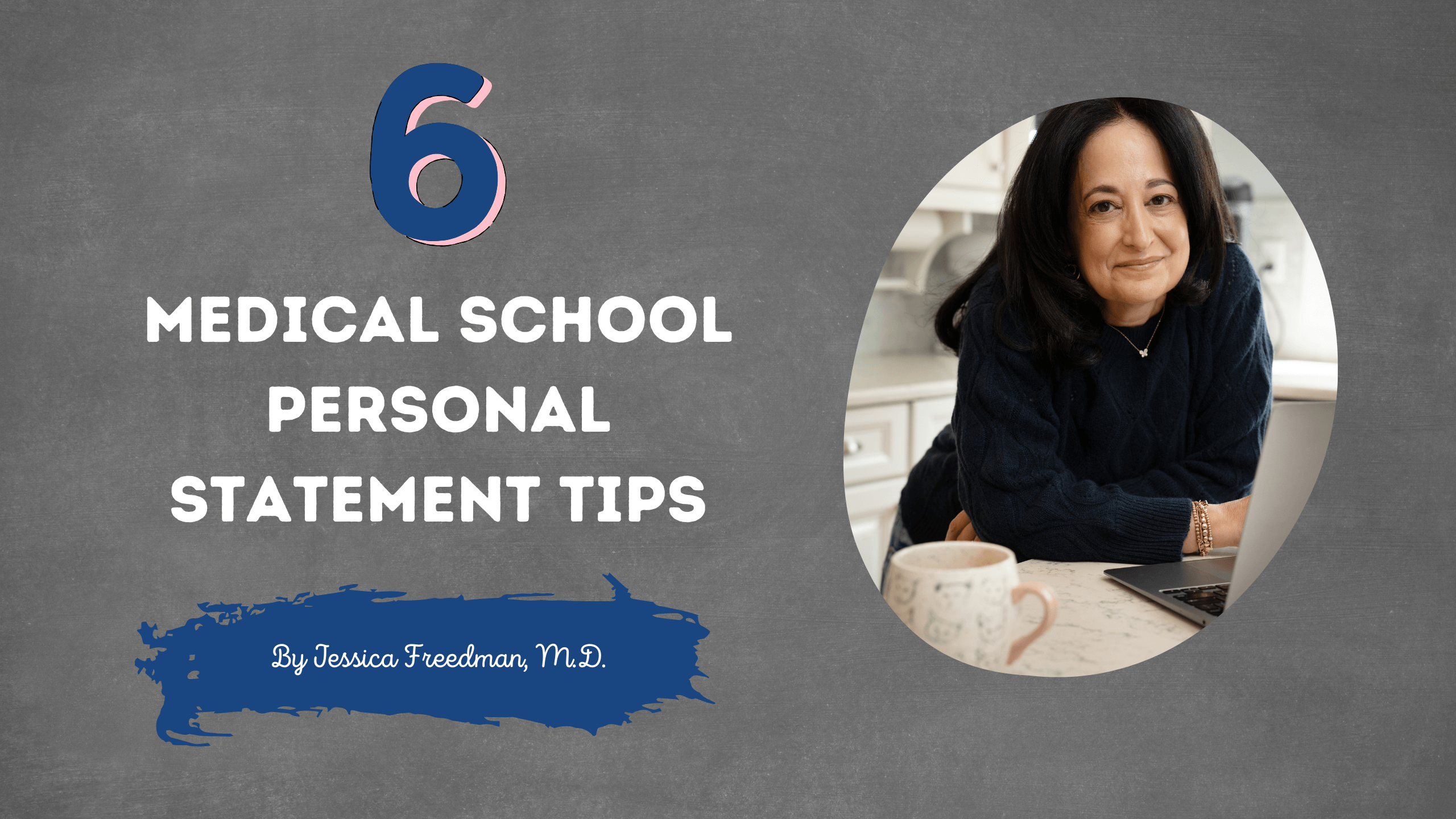
Jessica Freedman, M.D.
Jessica Freedman, M.D.

Jessica Freedman, M.D., is a board-certified emergency physician, former faculty member, medical school admissions committee member, and Associate Residency Director at the Icahn School of Medicine at Mount Sinai. She is the founder and chair of MedEdits Medical Admissions. Since 2007, she has helped thousands of students navigate the medical school admissions and residency match processes, with more than 95% of comprehensive clients gaining acceptance. She is the author of four books on medical admissions and host of The Oath podcast.

How to Start a Medical School Personal Statement

How to Start a Medical School Personal Statement

The first few sentences of your medical school personal statement position your reader immediately; do. they want to read more or are they dreading...

Read More
Medical School Personal Statement Examples and How to Write Your Own

Medical School Personal Statement Examples and How to Write Your Own

A physician and former medical school admissions committee member shares eight full medical school personal statement examples, explains why each one...

Read More
SIX MEDICAL SCHOOL PERSONAL STATEMENT TIPS

SIX MEDICAL SCHOOL PERSONAL STATEMENT TIPS

SIX MEDICAL SCHOOL PERSONAL STATEMENT TIPS Writing your medical school personal statement can feel like a daunting process. For many premeds, the...

Read More